

For several decades after the end of the Cold War, we became accustomed to thinking about international trade, technology and industrial policy primarily in economic terms. Trade was about efficiency and comparative advantage. Technology was largely the domain of private companies and innovation. Industrial policy was often regarded, particularly in the United States and Europe, as an outdated form of government intervention.
Today, all three have become instruments of geopolitical power.
The international position of the United States and the European Union will increasingly depend not only on their military capabilities or diplomatic influence, but also on their ability to control technologies, secure supply chains, maintain industrial capacity and shape the rules governing international trade. And this transformation is taking place above all against the background of strategic competition with China.
The globalization that developed after the Cold War was based on a powerful assumption: increasing economic interdependence would benefit everybody and would ultimately reduce political conflict. Production was consequently reorganized according to economic efficiency. Companies moved manufacturing where costs were lower. Supply chains became extraordinarily complex and geographically dispersed. China became the manufacturing center of the global economy, while the United States and Europe increasingly specialized in services, finance, advanced technologies and high-value manufacturing.
For many years this system produced enormous economic benefits. But it also created vulnerabilities.
The Covid-19 pandemic exposed the risks associated with excessive dependence on distant supply chains. The Russian invasion of Ukraine demonstrated how energy dependence could become a geopolitical vulnerability. And growing competition between the United States and China revealed that dependence on another country for semiconductors, critical minerals, batteries or telecommunications equipment could have national-security implications.
As a result, governments increasingly ask a different question. Not simply: where can we produce something most cheaply? But rather: who produces it, where is it produced, and can we depend upon that country during a geopolitical crisis?
This is the transition from globalization towards what we might call geoeconomics because trade policy is increasingly becoming security policy.
Concepts such as reshoring, near-shoring, friend-shoring, de-risking and strategic autonomy have entered the vocabulary of governments. The objective is not necessarily complete deglobalization. The more realistic objective is to reorganize globalization around considerations of security and political reliability. This leads us directly to industrial policy.
The return of industrial policy
For decades, particularly in Western economies, industrial policy had a rather bad reputation. Governments were supposed to create good economic conditions and then allow markets to determine where investment should occur. That intellectual consensus has weakened dramatically.
The United States began to revive industrial policy under the Biden administration – on a scale that would have appeared improbable twenty years ago – through the CHIPS and science Act and the Inflation reduction Act. Under the second Trump administration, the instruments have changed, but the strategic objective of rebuilding American industrial capacity has remained central. Tariffs, incentives for domestic production, restrictions on strategic imports and negotiations designed to attract investment to the United States have become important elements of economic policy.
The semiconductor sector illustrates this shift particularly clearly.
In January 2026, the US government argued that America manufactures only around 10 percent of the semiconductors it requires and explicitly described this dependence on foreign supply chains as an economic and national-security risk. Washington subsequently imposed a 25 percent tariff on certain advanced computing chips while providing exemptions where imports contribute to building American technological and manufacturing capacity. The semiconductor case shows how the distinction between trade policy, industrial policy and national security is disappearing.
The objective is no longer simply to buy semiconductors efficiently. The objective is to ensure that the United States retains the capacity to design, manufacture and control technologies that are essential to economic and military power. This brings us to emerging technologies.
Technology as geopolitical power
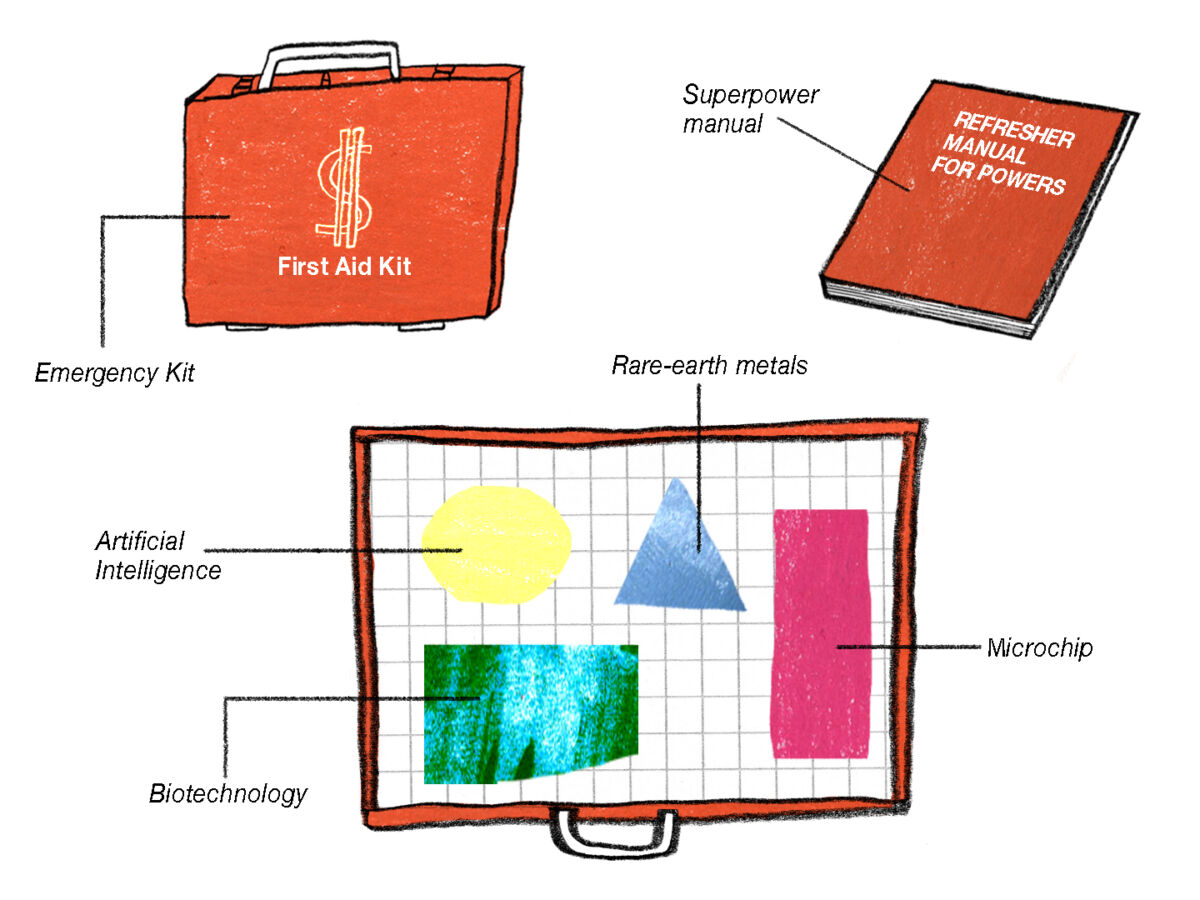
Artificial intelligence, advanced semiconductors, quantum computing, biotechnology, robotics, satellites and cyber capabilities are not simply new economic sectors. They are becoming the infrastructure of geopolitical power. AI can transform productivity, scientific research, intelligence analysis, logistics, military targeting, autonomous systems and cyber operations. But AI itself depends upon another strategic technology: advanced semiconductors, which in turn depend on extraordinarily complex global supply chains.
The United States possesses enormous strengths in chip design and AI. Taiwan remains crucial to advanced semiconductor manufacturing, South Korea to memory chips and Japan to critical materials and equipment. Europe possesses one particularly important strategic asset: advanced semiconductor-manufacturing equipment, especially through the Dutch technological ecosystem. China, meanwhile, has invested massively in reducing its dependence on foreign technology.
We therefore find ourselves facing something resembling a technological security dilemma. The United States attempts to prevent its most advanced technologies from strengthening China’s military and AI capabilities. China attempts to reduce its technological dependence on the United States and its allies. Both sides invest in domestic capacity. Technology therefore becomes simultaneously an economic asset, a military capability and an instrument of geopolitical leverage.
The US strategic advantage
How does this affect the geopolitical position of the United States? America enters this competition with extraordinary advantages. It possesses the world’s deepest capital markets, leading universities, enormous research capabilities and a uniquely powerful technology ecosystem. Many of the companies defining the artificial-intelligence revolution are American. The United States also possesses something Europe does not to the same extent: the ability to combine technological, military and financial power with geopolitical alliances.
This creates an ecosystem of strategic power. American universities generate research and talent. Venture capital finances innovation. Technology companies commercialize it. The federal government supports research and increasingly protects strategic sectors. The Pentagon creates enormous demand for advanced technologies. And alliances with Europe, Japan, South Korea, Australia and others extend America’s technological and industrial network far beyond its own territory.
But there is also a danger.
If economic security becomes excessive economic nationalism, the United States could weaken precisely the international networks that make American power so formidable. Tariffs may encourage domestic production, but they also increase costs. Protection may strengthen some industries while making downstream industries less competitive. And if allies begin to perceive American industrial policy as an attempt to transfer investment from their economies to the United States, economic competition can create political tensions within the Western alliance. The challenge for Washington is therefore to strengthen domestic resilience without destroying the international economic networks on which American power itself depends. The European Union faces a different problem.
Europe’s strategic dilemma
Europe remains one of the world’s largest economic and trading powers. It possesses sophisticated industries, excellent universities, major scientific capabilities and considerable regulatory influence. Europe is particularly strong in advanced manufacturing, aerospace, pharmaceuticals, chemicals, machinery, automotive technology and certain critical segments of the semiconductor supply chain.
But Europe suffers from three important strategic weaknesses.
The first is fragmentation. The United States operates as one continental economy with large capital markets and a federal government capable of mobilizing enormous resources. Europe possesses a single market, but capital markets, energy systems, defense procurement and industrial policies remain significantly fragmented along national lines.
The second problem is scale. Europe produces excellent technological companies but has struggled to create digital giants comparable to those of the United States. This matters enormously in artificial intelligence because AI leadership requires not only scientific excellence but huge quantities of capital, computing capacity, data and energy.
The third problem is strategic dependence. Europe depends heavily on imported energy, critical raw materials and certain digital technologies. For many years it also depended simultaneously on Russia for energy, China for manufacturing and the United States for security.
The geopolitical shocks of the last decade have demonstrated the risks inherent in this model. Europe’s response has increasingly been described through the concept of open strategic autonomy. Europe cannot realistically become economically self-sufficient, nor should it attempt: its prosperity depends heavily upon international trade.
The objective is therefore not autarky but resilience. Europe wants to remain open to the global economy while reducing dangerous dependencies in strategically important sectors. This explains initiatives concerning semiconductors, critical raw materials, batteries, clean technologies and defense production. It also explains the European Commission’s increasing emphasis on competitiveness and industrial policy. The Clean Industrial Deal and the new European framework for state aid reflect a recognition that European companies are competing in a world where the United States and China are themselves using powerful industrial policies.
But Europe faces a difficult balance: fragmentation is the main problem.
If every member state subsidizes its own national champions, industrial policy could fragment the Single Market. Germany and France have much greater fiscal resources than smaller member states. Therefore, an industrial strategy based primarily on national subsidies could paradoxically weaken European integration. Europe consequently needs industrial policy at the European level, not merely 27 parallel national industrial policies.
We can now see the larger strategic picture.
China has demonstrated that industrial policy can create extraordinary capabilities in areas such as electric vehicles, batteries, solar panels, telecommunications equipment and increasingly semiconductors. The United States has responded with a combination of industrial incentives, technological restrictions, tariffs and investment controls. Europe is attempting to develop a third model: maintaining an open economy while protecting strategic industries and reducing excessive dependencies.
But economic interdependence is not politically neutral. A supply chain creates both efficiency and dependence. And dependence creates potential leverage.
If one country controls a critical mineral, another controls advanced semiconductor equipment, another dominates cloud computing and another controls a major financial infrastructure, each possesses something that can potentially be converted into geopolitical influence. This means that the map of world power is becoming much more complicated. Military power remains fundamental, but we must increasingly add technological power, industrial power, financial power, energy power and control over supply chains. For thirty years, globalization encouraged us to believe that economics and geopolitics were gradually separating. Today they are coming together again.
The geopolitical competition of the twenty-first century will therefore not be decided exclusively by armies, nuclear weapons or diplomatic alliances. It will also be decided in semiconductor fabrication plants, AI laboratories, ports, electricity grids, battery factories, data centers and global supply chains.