

In 2021, a community of farmers who sell fresh produce at a Sunday market on the grounds of a religious school in the Badaro neighbourhood of Beirut began to recognise the potential to grow from one farmers market to several. But while souks may be a staple of Lebanese commerce and culture, they lack the governance to enforce the strict “grow it to sell it” ethos championed by farmers markets. It could be said that all roads lead to Souk El Tayeb. Beirut’s pioneering farm-to-market social enterprise launched in 2004 as a flagship to inspire others to run with the farm-to-consumer concept.
The Badaro Sunday farmers market is one of these next-generation institutions. While the Sunday scattering of tables may appear informal and ad hoc, Badaro organisers recognised that embedded in shoppers’ intense loyalty to defy roadblocks and more to shop are the seeds for deeper systems change. In the past five years, some shoppers became vendors, while other farmers diversified their offerings.
In particular, one farmer traded on his past experience in the fast-paced world of supermarket management and returned home to Lebanon to raise rabbits and vegetables on a small scale. Soon after joining the Badaro Urban Farmers Market as a vendor, Jean Charles Khairallah joined its board of directors.
As the market grew, so did the recognition that its potential extended beyond a single location. Before long, Badaro reached out to the emerging World Farmers Markets Coalition to learn how to expand to other locations with new farmers, new consumers, and new political arrangements with local governments.
Today, Badaro serves as a flagship operation for a national association – the Lebanon Farmers Markets Coalition – with new markets in Rayfoun, Tripoli, and Zouk Mikael. Whereas Souk El Tayeb may have proven that new markets were possible, it has been the timing and leadership of Badaro to envisage the political and economic power that comes with a network of markets, farmers, and consumers.
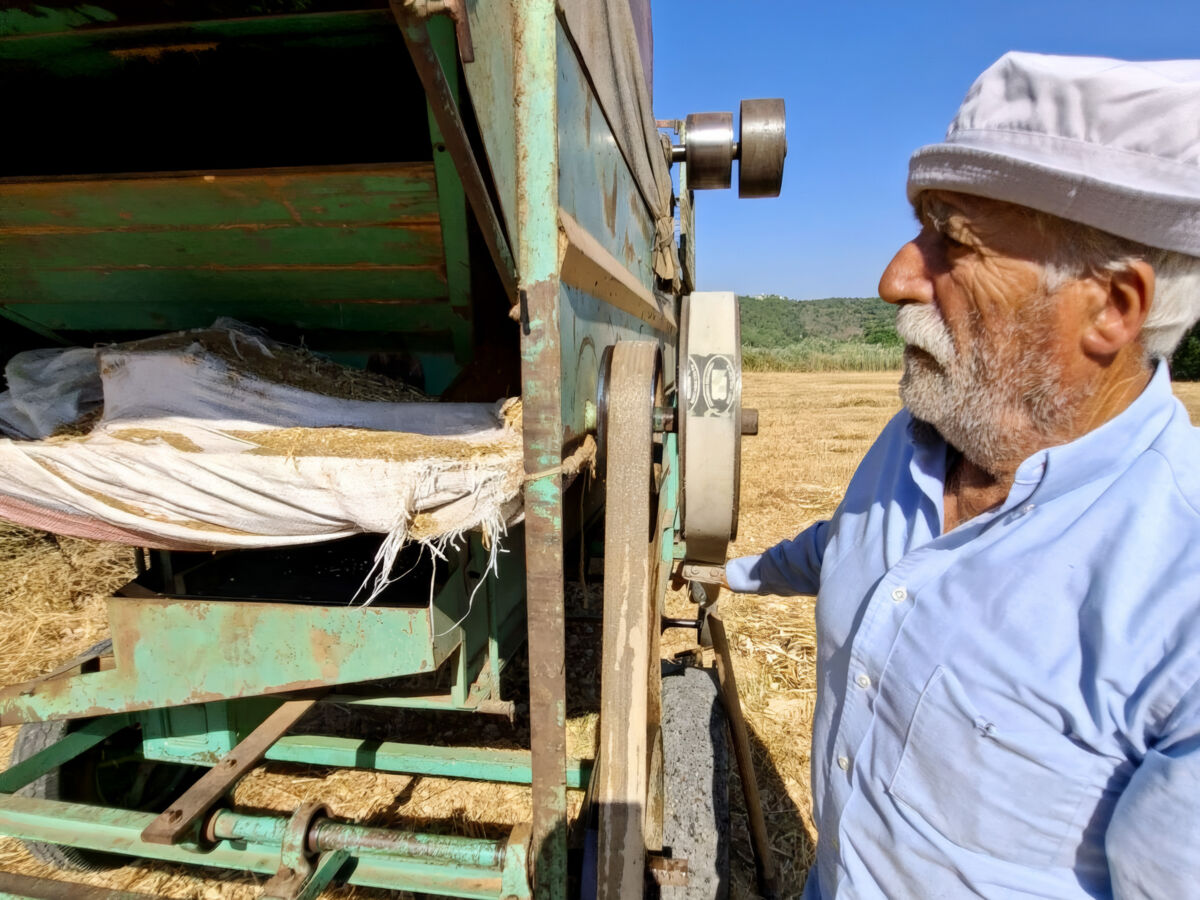
According to the World Bank, Lebanon imports roughly 80% of the wheat it consumes. Moreover, the trade journal, World Grain, reports that of the 20% of wheat produced locally, most of it is directed to bulgur, pasta, and semolina, with very little devoted to bread flour. As a result, if you are in Lebanon baking bread, chances are you are baking with flour from Ukraine and beyond. Considering the weakness of the Lebanese currency, bakers operate precariously. This concern bubbled to the surface when sourdough baker Charles Jabbour described his frustration with shortages of Lebanese Salamouri and Hourani flour for his breads to Jean Charles Khairallah. Together, they cooked up the idea to plant wheat for the farmers market. Not only would this fulfil the market’s desire to “grow it to sell it,” but it further leverages the farmers market as a tool to revive and diversify rural agri-food economies. Khairallah turned to a nearby 70-year-old farmer to sow 120 kg of an Italian wheat variety by hand on 3,000 square metres of family land. This was completed without the use of synthetic fertilizers and pesticides. The farmer, Ramez, doubted success. After months of luck and rain, Khairallah harvested 350 kg of wheat using dated and small-scale machinery.
Today, the wheat serves as a primary ingredient in Jabbour’s sourdough breads. Named as a programme, Sow the Bread, the Urban Farmers Market provides a useful window into the health of a local food system, its infrastructure, resources, etc. With each question raised, the answer points to additional questions: Are the skills to plant present? The labour? The processing equipment, etc.
In this regard, Lebanon continues to inspire the world with its resilience and creativity, in the face of challenging odds. Maybe here, beneath Lebanon’s tents and umbrellas, they are reimagining an import substitution that will sweep the world as it once did.
What is import substitution? It emerged as an economic strategy for nations to replace imports with domestic alternatives. In the process of decolonisation after the Second World War, this became a powerful and symbolic strategy to achieve national sovereignty. Whereas that era of import substitution may have risen as part of national liberation struggles, today’s import substitution is emerging not at the national level, but out of hyper-localised agri-food strategies that learn heavily upon frustrations with inconsistent global supplies of key provisions, like wheat and oil; consumer demands for transparency and quality in food systems; and a new language for self-determination: food sovereignty.
While this new articulation of import substitution may appear ideological, the experience in the farmers markets is quite the contrary. Pledged to defend pluralism, competition among vendors, and fairness for both supply and demand, the quest for food that is fresh, healthy, and local begins with a question. While the question in the 20th century may have been, why are we importing automobiles when we can make them here? Today, the questions are more modest, if not more basic: Why must we import wheat to bake our traditional breads? Is there a gap in the marketplace we can fill? If so, what will it take?
While Lebanon’s Urban Farmers Market network may be exploring which imported products could be replaced with local alternatives, it is not alone.
New York City’s GrowNYC launched a Regional Grains Project in 2009 on similar grounds. Very quickly, it learned both the potential for reviving local grain production, but also the weaknesses in the system: seed supplies, mills, and knowledge. This is where the experience in Lebanon’s farmers markets sheds light upon the strength in farmers markets operating in Europe. Are they sleeping giants? If granted the resources to enforce the local sourcing embedded in farmers market governance with programmes that invest in rural know-how and infrastructure, can we build better resilience in Europe?