

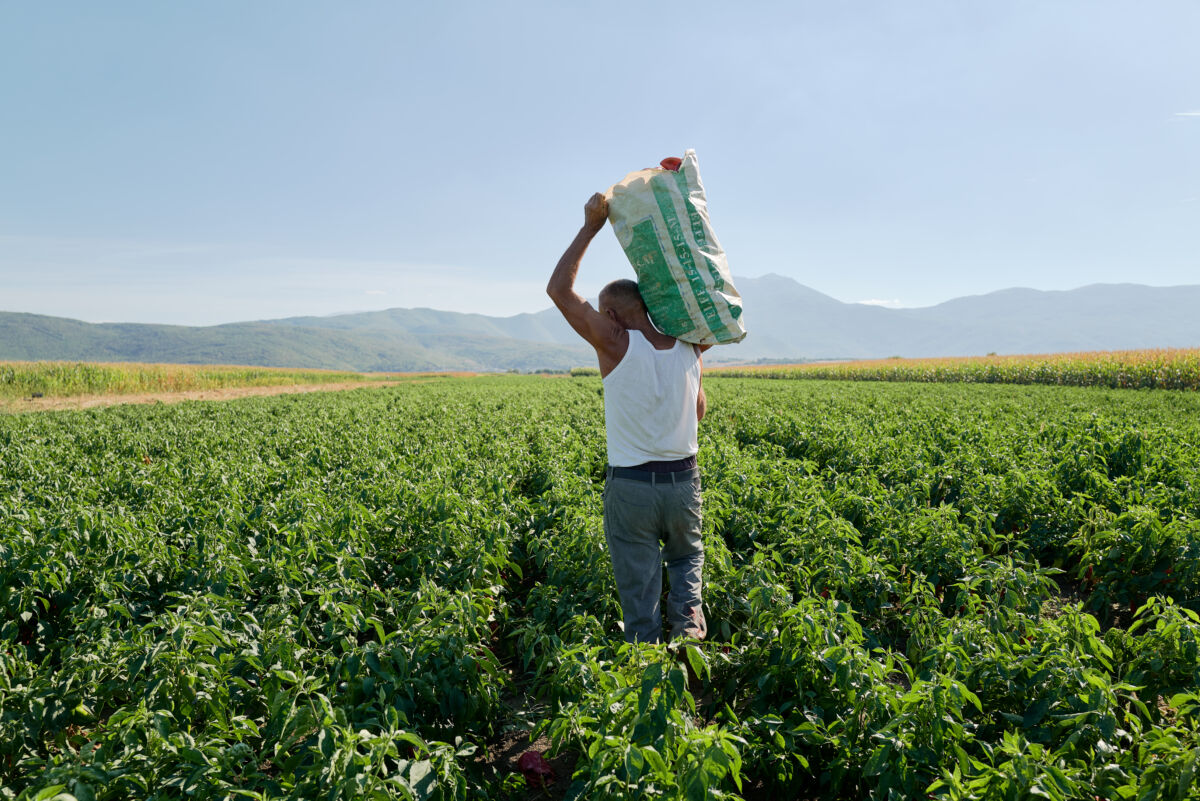
In a country where more than half the territory is classified as agricultural land, yet the average farm barely exceeds a hectare and a half, the difference between a good season and an economic setback is often decided not by weather or markets, but by something simpler: whether the farmer had someone to turn to about when, how, and what to plant. That “someone” has an institutional name: the agricultural advisory service and, in Kosovo, a far from linear history. Since the early 2010s it has moved through successive rounds of reform, externally funded projects, and national strategies, without yet fully consolidating its presence on the ground.
Kosovo’s advisory service did not emerge as a ready-made system; it was built gradually, within the post-war agricultural administration. As the Ministry of Agriculture, Forestry and Rural Development (MAFRD) itself documents, the advisory service developed over time and, under the 2013 regulations, was elevated to departmental status, before being organized, through the 2012–2016 strategy and the corresponding law, as a pluralist public-private service. That formula, part public and part private, remains the system’s basic architecture today: a central Department of Technical Advisory Services within the ministry, extended across the territory through advisory information centers in each municipality and complemented by licensed private organizations offering agricultural consultancy.
The current legal basis for this function is law 08/L-072 on Agriculture and rural development, which defines the advisory service as part of a public service that must be delivered continuously and without interruption, to every farmer or group of farmers engaged in agricultural activity, under programs and prices approved annually by the minister in cooperation with an intergovernmental group of experts.
Funding and technical support for the system have come largely from international partners. From the 2014–2020 strategy – prepared with support from a European Commission–funded project to strengthen MAFRD’s advisory services – to the current 2023–2027 strategy, developed with support from Caritas Switzerland under the Sustainable and Inclusive Rural Economic Development programme, the decision to invest in advisory capacity has been renewed with every planning cycle. The latest strategy foresees the advancement of the advisory-service system and the creation of seven regional advisory offices, while the 2023 monitoring report confirms the process has already produced concrete results: the establishment of those seven regional offices and the training of more than 6.500 farmers.
Even so, official documents do not hide the system’s weakest point. The same national strategy report openly acknowledges that, despite the establishment of regional offices, the small number of staff within the Department remains a challenge. In practice, this means that the institutional infrastructure, offices, regulations, strategies, exist on paper and, to some extent, in the field, yet the advisor-to-farmer ratio remains far from the standard needed to genuinely cover the country, particularly in the most rural municipalities furthest from regional centers.
This is not merely an administrative footnote; it bears directly on productivity. A dairy-processing farmer, for instance, needs ongoing guidance on livestock feed quality, milking hygiene, cooling and storage, and the hygiene and sanitary requirements increasingly aligned with European standards. Without a regular advisory presence on the ground, much of this knowledge remains fragmented – learned through repeated trial and error rather than through systematic knowledge transfer.
Beyond its technical function, the advisory service has also become something of a symbol on Kosovo’s path toward the European Union. Ministry officials have repeatedly placed it alongside other strategic priorities of the sector. In one past statement, the minister of the time listed the strengthening of the advisory service, together with international and regional cooperation, among the ministry’s main areas of engagement, beyond direct support to farmers through grants and subsidies. Similarly, during a seminar held in Pristina on strengthening the advisory system, officials noted that establishing information centers in municipalities is one of the most important elements of this service to farmers – indeed, a necessary step toward EU integration.
That connection is not merely rhetorical. Certification systems, phytosanitary standards, food-safety requirements, and future direct-payment schemes all require a farming population that is informed and equipped to adapt to regulatory change. Without a functioning advisory service, any legal approximation with the EU acquis risks remaining a technical exercise on paper – incomprehensible or unusable for the majority of small farmers who make up the overwhelming share of Kosovo’s agricultural structure.
The picture that emerges from institutional documents is one of a system still under construction: a clear legal foundation, a series of strategies backed by external funding, yet still constrained by the small number of people who keep it running on the ground every day. If the seven regional offices and the thousands of farmers trained so far represent the foundation, the challenge of the coming decade is scale – moving from donor-supported pilot projects to a sustainable public service, independent of external funding cycles, capable of accompanying every farmer in Kosovo, from the wheat fields to the small dairy-processing farm, toward a more productive agriculture better prepared for the European market.