

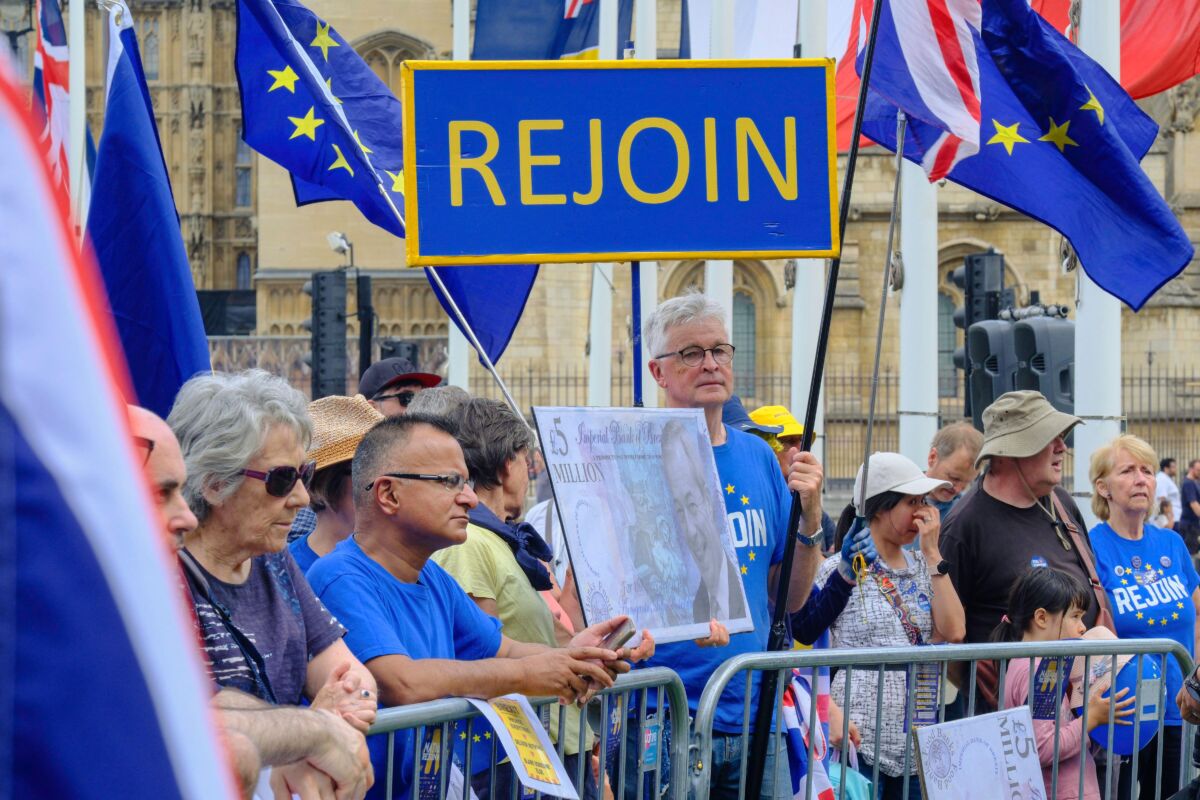
The Brexit referendum was supposed to settle Britain’s relationship with Europe. Instead, it raised fundamental questions about the country’s own identity. The 2016 vote split the nation down the middle: Leave won by 52 per cent to 48, ending a marriage to a Europe that the British, for decades, had treated as a reluctant stepmother, staying only half in and never joining her currency. The victors celebrated in the shadow of Big Ben, convinced that a richer, brighter future awaited.
Ten years on, after a pandemic and a run of international shocks, the numbers are not kind to those hopes.
Economists put the cost of Brexit at between 6 and 8 per cent of GDP by the end of 2025, according to a study co-authored by a Bank of England economist. Business investment is estimated to be 12 to 18 per cent lower, and employment and productivity 3 to 4 per cent lower. Exports to the EU have suffered from new customs and bureaucratic barriers.
The Office for Budget Responsibility, the official forecaster, has long predicted a 4 per cent hit to productivity in the long run, with trade volumes some 15 per cent lower than they would otherwise have been.
Estimates vary with the method used, and Brexit coincided with the pandemic and the energy shock that followed the invasion of Ukraine, which makes the hard to pin down. But the more recent studies all point in the same direction.
Politics has been no calmer.
The country has had seven prime ministers in ten years, an instability to which Britons were unaccustomed.
Net migration did not fall as the Leave campaign had promised; it hit a record in 2023. It peaked at 944,000 in the year to March 2023 and had fallen to about 204,000 by mid-2025, its lowest level since the pandemic. The fall owes much to tighter visa rules, but what has really changed is where migrants come from: India, China, Nigeria, Pakistan and Bangladesh rather than the EU.
So would Leave voters do it again? Polls suggest not many would.
Support for Leave is put at about 30 per cent, with 53 to 58 per cent now favouring a return to the EU.
Suze, 65, a lifelong Londoner, never wanted Brexit. “Leaving has done nothing but damage, in big things and small”, she says.
Sophia, 24, who had always supported Remain, now says: “The EU looks unstable at the moment, and in some ways I’m glad we no longer answer to its rules”.
The consequences of Brexit, however, have not been felt in the same way across the country. To better understand its contradictions, it is worth looking at two towns that voted overwhelmingly for Leave in 2016, but which today illustrate different aspects of that decision: Boston, in Lincolnshire, where the economic difficulties linked to leaving the EU are particularly evident, and Clacton-on-Sea, in Essex, where the political and social discontent that fuelled the Brexit vote continues to resonate.
In Boston, Lincolnshire, in 2016 some 75 per cent of voters backed Leave, the highest share in the country. In 2022, a study published by Guardian Carers named the small market town the unhappiest place to live in England. Despite its tidy, pleasant little streets, where cottage doorways are softened by gentle pastel shades, Boston is one of the most deprived areas of the Midlands. The surrounding county is a farming heartland, said to produce about 30 per cent of England’s vegetables and 18 per cent of its poultry. The 2011 census recorded the highest proportion of eastern Europeans in the country, drawn since 2004 to its food factories and fields. Many left after Brexit, and employers have struggled to fill the gaps; British workers have shown little appetite for the jobs they were once accused of “stealing”.
“With Brexit we have truly become an island”, says Adam, 46, who runs a bulb-growing business employing around 100 foreign workers a year. “I feared things would get worse, and now I’m certain. To cope with falling exports and staff shortages we opened two more sites, in Ireland and the Netherlands, to make trading with Europe easier”.
Anton Dani, a Moroccan-born businessman who was mayor of Boston from 2019 to 2021 and a leading Leave campaigner, sees it differently. For him the vote was about Brussels’s power over Britain and the rest of Europe, though for many in the town the real issue was immigration. “I’m optimistic”, he says. “I would vote for Brexit again, because it can offer new prospects to our town”. He cannot say when they will arrive. He must be a patient man if ten years still seems too soon.
Clacton-on-Sea, a small resort on the Essex coast, is the classic English holiday town in decline: bleakly deserted in winter and not very lively even in summer. It is not somewhere many Italians would choose for a summer holiday, and where, one imagines, the locals plunge into the icy sea and then sprint out to a hot cup of tea.
In 2016, 70 per cent here voted Leave. In 2024 it finally sent Nigel Farage, leader of Reform UK, to Westminster at his eighth attempt. This August he won the seat again, in a by-election he had triggered himself by resigning amid scrutiny of an undeclared £5 million donation.
Labour, the Conservatives and the other main parties boycotted the contest, which he won with about 63 per cent of the vote. Even here, opinion has shifted. Many still think leaving was right; some regret it bitterly.
“If I had to vote again, I’d vote to stay”, says Jill Ayling, 76. “We didn’t know the whole truth. We thought the NHS would get more money, and it didn’t. Our politicians lied to us. And things have gotten worse for young people”.
Ronald Odnie, 74, also voted Leave, and blames political instability for Brexit’s troubles rather than the reverse.
The government, led by Labour’s Mr Burnham, sees it differently. He has said he hopes to see Britain rejoin the EU in his lifetime. A former mayor of Greater Manchester who campaigned for Remain, Mr Burnham became prime minister on 20 July after succeeding Sir Keir Starmer as Labour leader. In the Commons, he said that the status quo was “not good enough for Britain”.
His opponents have wasted no time. Mr Farage says he cannot be trusted to defend British sovereignty, while the Conservative leader, Kemi Badenoch, accuses him of unpicking the deal the country signed with the EU. Talks are reported to have stalled over British concerns about the EU’s “Made in Europe” plans to protect certain industries. At a Brussels summit on November 20 he agreed a new deal on food exports, youth mobility and emissions.
Britain’s return to the Erasmus programme, agreed last December, will cost about £570 million for the 2027-28 academic year, a 30 per cent discount on the standard terms, and the government expects more than 100,000 people to take part in the first year. The aim is to revive growth, badly hurt by Brexit and the deal that followed. A second referendum on rejoining is no longer taboo.
“This country needs to know where it is heading over the next ten years,” Mr Burnham has said, “and this time the people will decide”.
Not a terribly original promise, alas. Others made it ten years ago.