


“This is what’s wrong with Britain”. Nate Silver, the American statistician, made this criticism on X when a YouGov poll went viral in July: £50,000 now, or a coin toss for £1 million. Nearly three in four Britons chose the guaranteed money. But when the same question was subsequently put to Americans and Italians, the gap between the three populations turned out to be surprisingly narrow. That is precisely what makes the results more interesting than any national diagnosis.
Better a sure thing today than a promise of more tomorrow

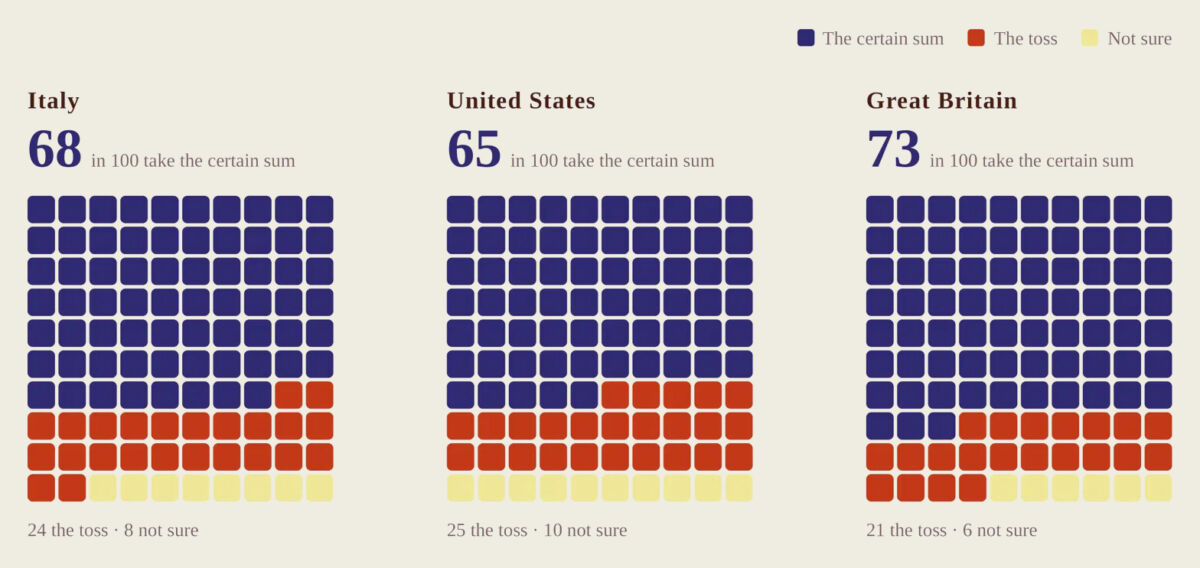
Caution may look like a shared national trait, but it may reveal something more crucial about how people respond to a sum that could make an immediate difference in their life: a debt paid off, a deposit put down, months of financial breathing room. On the other side of the coin lies an equal chance of walking away with nothing and losing an opportunity that might never come again.
For someone living on a tight budget, the choice is not between £50,000 and £1 million. It is between something and nothing.
In the landmark paper published in Econometrica in 1979, Daniel Kahneman and Amos Tversky helped explain why certainty carries more weight than probability alone, and why a 50-50 gamble is rarely perceived in purely mathematical terms.
From the respondent’s perspective, the gamble is perceived as being worth less than its objective value on paper. Fifty thousand pounds is an ordinary relief: a concrete sum that can be put to use immediately. The million belongs to a different ballpark figure: an image, close to a fantasy, rather than a solid plan.
Seen in this light, the choice no longer looks like a failure of arithmetic. It becomes a measure of how much financial room for manoeuvre a person has. The gamble is harder to justify when there are immediate bills to pay and specific obligations to meet; it becomes more tempting when no ordinary sum of money would substantially change one’s life.
This is the interpretation offered by Uri Gneezy, an economist at the University of California, San Diego, who sees the viral response as revealing more about financial pressure than about national temperament.
Ultimately, what the poll measures is not so much a society’s appetite for risk as the weight that 50,000 – whether in pounds, euros or dollars – carries in the everyday life of the person answering the question.
And the similarity between the three countries suggests that this weight is roughly the same everywhere. What emerges is a single widespread condition, in which the margin is thin enough to make certainty impossible to turn down.